Showing posts with label Strategies. Show all posts

Friday, May 23, 2014

Why children need discipline


Introduction
Many parents don’t set - or don't enforce - rules for their kids because they don’t want to be the villain but setting your child limits is vital for teaching him self-control.

How rules help your child feel secure
One of the main parent pitfalls Supernanny Jo Frost tackles in her sessions with families on the show is failing to set rules because you don’t want to be too tough on your kids. Trouble is this often means parents end up losing control because they’re too soft to enforce boundaries and follow up bad behavior with consequences.
Few aspects of parenting are as important as discipline. The bottom line is that it helps your child feel secure and determines what kind of person he’ll grow up to be.

Discipline or punishment?
So many parents confuse discipline with punishment and part of Supernanny’s mission is to show parents that managing their kids’ behavior needn’t be a negative experience. See discipline as a way of teaching your child self-control instead of a way of controlling your child, and you’re well on the way to appreciating that it can be a positive learning experience. Once you’ve helped build that sense of self-control you’ve effectively taught your child the skill of disciplining himself.

Why kids need rules
Your house rules set limits and boundaries for your child that help him think in an orderly way and get along with other kids and adults. They impact on his academic success – think about how the discipline he learns from you is the basis for his behavior at school – demonstrate that there are consequences to his actions and keep him safe. Helping him stick to the rules will make him way more pleasant to have around and be around and his sense of self-control is a vital skill he can fall back on during his teen years, when making wise decisions may run counter to his desire to rebel.

Keeping it positive
If discipline isn’t the same as punishment, that definitely rules out spanking. Although some parents see it as the ideal short, sharp shock, especially if their child is engaging in behavior that risks his safety, using it for day-to-day punishment risks teaching your child that physical aggression is OK. Always keep in mind that you’re aiming to teach your child what behavior is acceptable – not punish him for being bad.

How to discipline when you really don’t want to…
Some parents just don’t want to be the bad guy; others let their kids get away with doing what they like when and where they like because they’re afraid saying no will result in a tantrum. Others had harsh discipline meted out to them when they were young and don’t want their kids to feel the way they did. What you have to remember is that you owe it to your child to raise him to be a responsible adult – and teaching him how to behave is a big part of that. How do you do it?
  1. Don’t see your child as bad
    Instead of coming at discipline from the angle that your child has intentionally done something naughty, try see his acting up as a lapse in judgment. This makes it easier for you to discipline him in a positive way because you’ll be more inclined to focus on teaching him what’s acceptable.
  2. Make his routine consistent
    Set regular times for meals, homework and bedtime. If he knows it’s set in stone that he does something at a particular time, he’s less likely to act up when you tell him to go do it.
  3. Don’t make rules he can’t keep
    Be reasonable when it comes to the house rules. Involve your child as much as possible in compiling them and before making each rule, think about whether it’s really necessary and whether you might be effectively setting traps for him by laying down laws he can’t possibly stick to. Make sure your rules are appropriate for his age and accept that you might need to be more flexible as he gets older and needs more independence.
  4. Consistently enforce consequences One of Supernanny’s top rules of discipline is to follow through with consequences for bad behavior. One of the best ways to deter your child from acting up is to show him you - and all his carers - mean business when it comes to consequences – if he thinks you’re a soft touch he won’t have any incentive to follow the rules.
  5. Remove temptation
    Young children have very little self-control, so don’t leave temptation in his way. Let’s face it: if he can reach the snack jar he’s sure to raid it half an hour before his dinner is ready! Avoid having to discipline him for it by not leaving behavior booby traps in his path – instead create an environment that promotes good behavior.
  6. Watch the dos and don’ts
    Reframe your discipline vocabulary. For example, instead of saying, “Josh, don’t snatch that toy from Cody”, say “It’s Cody’s turn to play with that toy now, Josh”. In this way you’re telling your child what to do instead of constantly telling him what not to do.
by Supernanny Team

Article retrieved from: http://www.supernanny.co.uk/Advice/-/Parenting-Skills/-/Discipline-and-Reward/Why-children-need-discipline.aspx

Image retrieved from: http://www.scholastic.com/parents/sites/default/files/field_asset_image/daily-tips-6-7-learning-school-how-to-teach-right-and-wrong.jpg

Monday, May 19, 2014

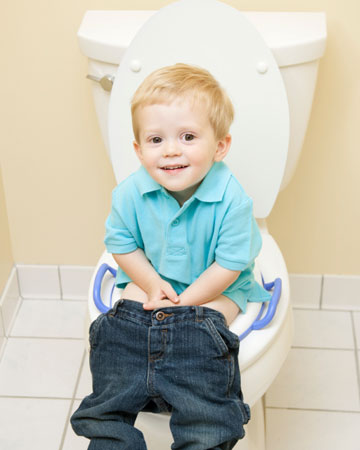
Potty training: What works

Reviewed by the BabyCenter Medical Advisory Board
To make potty training as smooth a process as possible for you and your toddler, take a moment to learn what tends to work - and what doesn't. What works:

Waiting till your child is ready

There's no magic age for being ready to start learning to use the potty. Most toddlers develop the necessary physical and mental skills between 18 and 24 months, while some kids aren't there until closer to age 3 or even 4. Keep an eye out for physical, cognitive, and behavioral signs that your toddler might be ready to give it a try.
If your toddler is facing changes such as a new school, a new sibling, or travel, you may want to wait till the seas are calmer before taking the plunge.
Once you do start, if you've been trying for several weeks without success, that's a sign your toddler's not ready. Wait a few more weeks - or until you see signs that the time is right - and try again.

Making a plan

Before you even buy your toddler a potty seat, it's important to have a plan for the training process itself. Decide when and how you want to start, how to handle accidents, when to back off, and so on.
At the same time, prepare to be flexible. There's no way to know how your child will respond to potty training attempts or what techniques will work best. Keep in mind that as with most developmental milestones, success doesn't necessarily happen in a linear fashion - your toddler may make initial progress only to regress at one or more points along the way.

Discuss your plan with your child's pediatrician and daycare provider. They'll probably have plenty of experience and advice to share. Once you've decided on a strategy, be sure you and everyone else who takes care of your child sticks to it - barring unexpected setbacks and other potty training challenges, of course.

Taking it slow

Mastering the various steps of potty training can take a long time. Yes, some children will have it nailed in just a few days, but most need weeks or even months, especially when they're working on staying dry at night.
Don't push your toddler (or let others push him) to get through potty training faster than he's ready to. Let him take his time and get used to this new, multipart process. He'll move from one stage to the next at his own speed.

Of course, it's perfectly all right to try to motivate with gentle reminders and encouragement. If he balks, though, ease up.

Praising your child

Throughout potty training, your toddler will respond to positive reinforcement. Whenever he moves on to a new step or tries to use his potty (even when he doesn't quite succeed), tell him he's doing well and that you're proud of him. Compliment him now and then on his dry underpants or diaper.
But be careful not to go overboard: Too much praise might make him nervous and afraid to fail, which can lead to more accidents and setbacks.

Accepting that there will be accidents

It's likely your toddler will have numerous accidents before being completely potty-trained. Don't get angry or punish him. After all, it's only recently that his nervous system has matured enough for him to perceive the sensation of a full bladder or rectum and that his muscles have developed sufficiently to allow him to hold in his urine and stool - and that's if he's on the early end of the developmental spectrum.

He'll get the hang of the process in due time. When your toddler has an accident, calmly clean it up and suggest (sweetly) that next time he try using his potty instead.

Article retrieved from: http://www.babycenter.com/0_potty-training-what-works_4397.bc?page=1 & http://www.babycenter.com/0_potty-training-what-works_4397.bc?page=2
Image retrieved from: http://cdn.sheknows.com/articles/2012/04/sarah_parenting/potty-training.jpg

Throwing: Why toddlers throw things


Throwing things is a new and enjoyable skill for many children between 18 months and 3 years of age. It takes fine-motor skills to open the fingers and let go of an object, and considerable hand-eye coordination to actually throw it. No wonder your toddler wants to practice this exciting skill!
What happens next is educational, too: Your toddler discovers that whatever she throws falls down — never up. She can't say "gravity," but she can certainly observe its effects. If she throws a ball, it bounces. If she tosses a plum, it goes splat.

Of course, for you it's maddening when spaghetti winds up all over your just-mopped kitchen floor or a clean pacifier lands on a dirty sidewalk, but to your toddler, it's all great fun.

What you can do about it

"Unless your toddler's throwing a rock through a window or really threatening to hurt someone, don't give her a time-out or punish her," says Roni Leiderman, associate dean of the Family Center at Nova Southeastern University in Fort Lauderdale, Florida. It's futile to try to stop your child from throwing at this age. Concentrate instead on limiting what she throws and where she throws it with these tips.

Show her what she can throw. Your toddler will learn what not to throw more quickly if there are lots of things that she is allowed—and even encouraged—to throw. Balls are an obvious choice (stocking up on foam balls will minimize accidents indoors). But actual throwing games (like tossing beanbags in a basket or skipping stones on a pond) are even more fun for a 2-year-old, especially if you play with her.

The message you want to convey is that throwing things is fine as long as she throws the right things in the right place at the right time. "When she throws something inappropriate, like a shoe, calmly take it away from her and say, 'Shoes aren't for throwing, but balls are.' Then give her a ball to play with," says Leiderman.

Discourage her aggressive throwing. What should you do when your toddler does throw something she shouldn't—sand from the sandbox, for instance, or blocks at another child? As much as possible, try to ignore it the first few times it happens. If she knows she can get your attention by throwing something she shouldn't at someone, she's likely to do it again.

If your child often comes close to hurting other children by throwing things at them, it's important that you always react the same way, since toddlers learn through repetition. The next time she does it, say, "No, that hurts," and pull her aside for a quick time-out to call attention to the "no" and to remove her from the situation so she can start fresh in a moment.

The key is to keep the time-out under a minute (a good rule of thumb is 60 seconds for every year of age) so your child doesn't forget why she was made to stop what she was doing.
If you notice that she throws things at other children when she gets angry, encourage her to express herself with words instead. Say, "If you're angry at Emily, use your words," or, "You tell me when you get angry."

It's okay to let her know you're unhappy with her behavior by your tone of voice, just don't let your anger determine your response. Try not to yell at your child, and never hit her—even if it's just her hand—to discourage her from throwing.

If she persists in throwing things in a hurtful manner, even though you've tried to deter her calmly and consistently, you may have no choice but to keep an eagle eye on the toys she plays with, and to shadow her while she plays with them.

Fasten her toys to her seat. When she's in her stroller or car seat, try attaching a few playthings within easy reach (tie the toys with short pieces of string and trim the ends so they can't get wrapped around her neck). She'll quickly discover that in addition to throwing the objects, she can fish them back again. Double the fun for her, half the work for you.

Clean up together. Don't ask your toddler to pick up everything she throws. "That's an overwhelming task for a child this age," says Leiderman. Instead, try getting down on your hands and knees together and enlisting her help by saying, "Let's see how fast we can pick up the blocks together," or "Can you help me find all the yellow M&M pieces?"

Set a good example. You don't have to avoid casually tossing a pillow on the sofa to set a good example for your toddler. In fact, you can use the items you normally toss around your home to show her what's good to throw and what's not. The next time she throws something she shouldn't, take a tour of your house together and toss socks in the hamper, tissues in the wastebasket, and toys in the toy chest instead.

Sit with her at mealtimes. This is a messy eating stage, but you can often avoid the worst of it by sitting down with your toddler while she eats. That way you're right there to gently but firmly tell her no when she makes a move to toss her lunch and to hold her plate down with your hand if need be.

"Parents should always sit with their children at mealtimes to engage them in conversation and help develop their language skills," says Leiderman. It's also the best way to make sure your toddler chews her food before swallowing so she doesn't choke.

Use toddler-proof dishes. "Never use your fine china or even breakable stoneware to feed your toddler," says Leiderman. Instead, try using a special toddler dish with suction cups that fasten to the table or highchair tray so she can't pick up the dish. Keep in mind, though, that while these work well enough that a casual grab won't send her dish scuttling across the floor, they won't stop a child who's amazed to find her dish "stuck" and is determined to pry it off.

Stick to small portions. You'll waste less and your toddler will have less ammunition if you serve her tiny portions of finger foods and hold off on dishing up more until she's eaten what's there. "Don't push her to eat more than she wants to unless your pediatrician says she's having trouble thriving," says Leiderman.

Most kids don't start throwing their food until they've finished eating and grown bored. So no matter how much she's eaten, take your toddler's food-flinging as a sign that she's finished her meal, and remove her from the table or her highchair.


If a bit of food does escape her hands, either by accident or on purpose, try to keep some perspective about it. After all, a dropped slice of bread or a pinch of grated cheese on the floor may be annoying, but we all drop things sometimes.

Article retrieved from: http://www.babycenter.com/0_throwing_1200989.bc?scid=momstodd_20130903:2&pe=MlVBUEhFenwyMDEzMDkwMw..
Image retrieved from: http://www.kidspot.com.au/wp-content/uploads/2013/05/toddler-throwing-things_1000x750-660x495.jpg

Twitter Delicious Facebook Digg Stumbleupon Favorites More