Showing posts with label Child's development. Show all posts

Friday, May 23, 2014

Why children need discipline


Introduction
Many parents don’t set - or don't enforce - rules for their kids because they don’t want to be the villain but setting your child limits is vital for teaching him self-control.

How rules help your child feel secure
One of the main parent pitfalls Supernanny Jo Frost tackles in her sessions with families on the show is failing to set rules because you don’t want to be too tough on your kids. Trouble is this often means parents end up losing control because they’re too soft to enforce boundaries and follow up bad behavior with consequences.
Few aspects of parenting are as important as discipline. The bottom line is that it helps your child feel secure and determines what kind of person he’ll grow up to be.

Discipline or punishment?
So many parents confuse discipline with punishment and part of Supernanny’s mission is to show parents that managing their kids’ behavior needn’t be a negative experience. See discipline as a way of teaching your child self-control instead of a way of controlling your child, and you’re well on the way to appreciating that it can be a positive learning experience. Once you’ve helped build that sense of self-control you’ve effectively taught your child the skill of disciplining himself.

Why kids need rules
Your house rules set limits and boundaries for your child that help him think in an orderly way and get along with other kids and adults. They impact on his academic success – think about how the discipline he learns from you is the basis for his behavior at school – demonstrate that there are consequences to his actions and keep him safe. Helping him stick to the rules will make him way more pleasant to have around and be around and his sense of self-control is a vital skill he can fall back on during his teen years, when making wise decisions may run counter to his desire to rebel.

Keeping it positive
If discipline isn’t the same as punishment, that definitely rules out spanking. Although some parents see it as the ideal short, sharp shock, especially if their child is engaging in behavior that risks his safety, using it for day-to-day punishment risks teaching your child that physical aggression is OK. Always keep in mind that you’re aiming to teach your child what behavior is acceptable – not punish him for being bad.

How to discipline when you really don’t want to…
Some parents just don’t want to be the bad guy; others let their kids get away with doing what they like when and where they like because they’re afraid saying no will result in a tantrum. Others had harsh discipline meted out to them when they were young and don’t want their kids to feel the way they did. What you have to remember is that you owe it to your child to raise him to be a responsible adult – and teaching him how to behave is a big part of that. How do you do it?
  1. Don’t see your child as bad
    Instead of coming at discipline from the angle that your child has intentionally done something naughty, try see his acting up as a lapse in judgment. This makes it easier for you to discipline him in a positive way because you’ll be more inclined to focus on teaching him what’s acceptable.
  2. Make his routine consistent
    Set regular times for meals, homework and bedtime. If he knows it’s set in stone that he does something at a particular time, he’s less likely to act up when you tell him to go do it.
  3. Don’t make rules he can’t keep
    Be reasonable when it comes to the house rules. Involve your child as much as possible in compiling them and before making each rule, think about whether it’s really necessary and whether you might be effectively setting traps for him by laying down laws he can’t possibly stick to. Make sure your rules are appropriate for his age and accept that you might need to be more flexible as he gets older and needs more independence.
  4. Consistently enforce consequences One of Supernanny’s top rules of discipline is to follow through with consequences for bad behavior. One of the best ways to deter your child from acting up is to show him you - and all his carers - mean business when it comes to consequences – if he thinks you’re a soft touch he won’t have any incentive to follow the rules.
  5. Remove temptation
    Young children have very little self-control, so don’t leave temptation in his way. Let’s face it: if he can reach the snack jar he’s sure to raid it half an hour before his dinner is ready! Avoid having to discipline him for it by not leaving behavior booby traps in his path – instead create an environment that promotes good behavior.
  6. Watch the dos and don’ts
    Reframe your discipline vocabulary. For example, instead of saying, “Josh, don’t snatch that toy from Cody”, say “It’s Cody’s turn to play with that toy now, Josh”. In this way you’re telling your child what to do instead of constantly telling him what not to do.
by Supernanny Team

Article retrieved from: http://www.supernanny.co.uk/Advice/-/Parenting-Skills/-/Discipline-and-Reward/Why-children-need-discipline.aspx

Image retrieved from: http://www.scholastic.com/parents/sites/default/files/field_asset_image/daily-tips-6-7-learning-school-how-to-teach-right-and-wrong.jpg

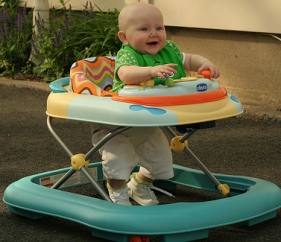
The Dangers of Baby Walkers


Q.
D. J. from New York City asks the Consults blog:
I know some people use baby walkers to help young children learn to walk. Is it true that this may actually be harmful to developing bones and muscles?

A.
Pediatrician Dr. Alan Greene responds:
It’s so exciting to see a baby take the first step! When wheeled seats arrived on the scene that would allow babies to move around with their feet on the floor, parents and babies alike were delighted. Some parents still use these baby walkers to help their children learn to walk or to give them some exercise or mobility. Some use baby walkers almost like pacifiers for the legs: many babies seem happier when they are propelling themselves across the floor.

And let’s face it, sometimes parents need to get things done. Sometimes parents use walkers as a baby-sitter, to keep their baby occupied and entertained so they do other things.
Parents should know that walker use typically delays motor development – and that it delays mental development even more. Beyond this, walker use is dangerous.

Back in 1994, when baby walkers were still extremely popular in the United States, the Consumer Products Safety Commission declared that baby walkers were responsible for more injuries than any other children’s product. The types of injuries included head injuries, broken bones, broken teeth, burns, entrapment of fingers and even amputations or death.

Walkers allow mobility beyond a baby’s natural capability, and faster than a parent’s reaction time. Most of the injuries involve falls down stairs, but injuries can also come, for instance, from allowing reach to hot, heavy or poisonous objects. Today’s walkers are safer, but they are still hazardous – and of no benefit to the baby.

Canada banned baby walkers in 2004. Possession of a baby walker can lead to fines up to $100,000 or six months in jail. But in some countries, more than 75 percent of babies still use walkers– and the injuries continue.

Sometime in the second half of the first year, healthy babies develop a strong urge to move across the floor. At first, this is a struggle for them as they work their arms and legs, stretching, rolling, scooting or crawling. They find delight in accomplishment as they achieve their goal of a toy out of reach. Later, the focus of their work will turn to pulling themselves upright.
Babies who use a walker skip some of this magnificent developmental journey. With their toes in an unnatural position, they glide across the floor with ease, moving upright before their time.
What’s the outcome?

Besides the added dangers of moving faster, falling farther and reaching higher, babies who use walkers learn to crawl, stand and walk later than they would have otherwise, and continue to show delayed motor development for months after they have learned to walk. The delay seems to be a little more than three days for every 24 hours of total walker use.

But the biggest delays – and the biggest surprise to many parents – are delays in mental development and lower scores on mental developmental testing, still present 10 months after initial walker use.

Stationary activity centers for babies can provide many of the benefits parents are looking for from walkers, without the serious problems.

I’m so glad for your question. Almost every week I still come across a parent who is using a walker in the mistaken belief that it will benefit their children, unaware of the risks and the costs of walker use.


Alan Greene, M.D., is the founder of the Web site DrGreene.com and the author of “From First Kicks to First Steps.”

Article retrieved from: http://consults.blogs.nytimes.com/2010/02/22/the-dangers-of-baby-walkers/?_php=true&_type=blogs&_r=0
Image retrieved from: http://www.newbornbabyzone.com/wp-content/uploads/2008/08/baby-walker.jpg

Monday, May 19, 2014

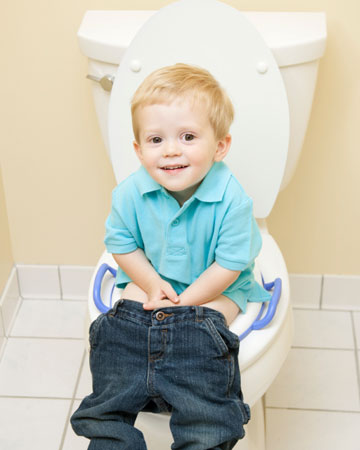
Potty training: What works

Reviewed by the BabyCenter Medical Advisory Board
To make potty training as smooth a process as possible for you and your toddler, take a moment to learn what tends to work - and what doesn't. What works:

Waiting till your child is ready

There's no magic age for being ready to start learning to use the potty. Most toddlers develop the necessary physical and mental skills between 18 and 24 months, while some kids aren't there until closer to age 3 or even 4. Keep an eye out for physical, cognitive, and behavioral signs that your toddler might be ready to give it a try.
If your toddler is facing changes such as a new school, a new sibling, or travel, you may want to wait till the seas are calmer before taking the plunge.
Once you do start, if you've been trying for several weeks without success, that's a sign your toddler's not ready. Wait a few more weeks - or until you see signs that the time is right - and try again.

Making a plan

Before you even buy your toddler a potty seat, it's important to have a plan for the training process itself. Decide when and how you want to start, how to handle accidents, when to back off, and so on.
At the same time, prepare to be flexible. There's no way to know how your child will respond to potty training attempts or what techniques will work best. Keep in mind that as with most developmental milestones, success doesn't necessarily happen in a linear fashion - your toddler may make initial progress only to regress at one or more points along the way.

Discuss your plan with your child's pediatrician and daycare provider. They'll probably have plenty of experience and advice to share. Once you've decided on a strategy, be sure you and everyone else who takes care of your child sticks to it - barring unexpected setbacks and other potty training challenges, of course.

Taking it slow

Mastering the various steps of potty training can take a long time. Yes, some children will have it nailed in just a few days, but most need weeks or even months, especially when they're working on staying dry at night.
Don't push your toddler (or let others push him) to get through potty training faster than he's ready to. Let him take his time and get used to this new, multipart process. He'll move from one stage to the next at his own speed.

Of course, it's perfectly all right to try to motivate with gentle reminders and encouragement. If he balks, though, ease up.

Praising your child

Throughout potty training, your toddler will respond to positive reinforcement. Whenever he moves on to a new step or tries to use his potty (even when he doesn't quite succeed), tell him he's doing well and that you're proud of him. Compliment him now and then on his dry underpants or diaper.
But be careful not to go overboard: Too much praise might make him nervous and afraid to fail, which can lead to more accidents and setbacks.

Accepting that there will be accidents

It's likely your toddler will have numerous accidents before being completely potty-trained. Don't get angry or punish him. After all, it's only recently that his nervous system has matured enough for him to perceive the sensation of a full bladder or rectum and that his muscles have developed sufficiently to allow him to hold in his urine and stool - and that's if he's on the early end of the developmental spectrum.

He'll get the hang of the process in due time. When your toddler has an accident, calmly clean it up and suggest (sweetly) that next time he try using his potty instead.

Article retrieved from: http://www.babycenter.com/0_potty-training-what-works_4397.bc?page=1 & http://www.babycenter.com/0_potty-training-what-works_4397.bc?page=2
Image retrieved from: http://cdn.sheknows.com/articles/2012/04/sarah_parenting/potty-training.jpg

Unsung milestones

By Dan Tynan and Christina Wood 

We all know when kids should sit up, walk, talk, and get a driver's license. But what about some of those other important "firsts" that don't get as much press? Here are seven milestones that we think deserve more notice.

1 What: Sees in stereo
When: 2 to 4 months

Your baby used to see in two dimensions, but now he's seeing the world in three. His cerebral cortex has matured enough that he can merge the input from both eyes — no goofy 3-D glasses required.

2 What: First true laugh
When: 4 to 5 months

Babies start smiling at 2 to 3 months, but at around 4 to 5 months that smile may turn to laughter in response to surprising or incongruous events, thanks to her rapidly developing cerebral cortex. Finally, someone to laugh at your Three Stooges antics.

3 What: Knows her own name
When: 5 to 8 months

Though she won't be able to speak it for some time, by this age your baby knows her own name and will look up if you call it. Good luck getting her to continue doing this throughout her teenage years.

4 What: Plays with privates
When: 1 to 2 years

By this age, many children have discovered that it feels good to touch their privates. It's all sensation at this point. They won't be angry at you for barging into the room without knocking for a long time yet.

5 What: Pumps on a swing
When: 4 to 5 years

A child this age can finally figure out how to pump her legs on a swing. Now you can drink your coffee in peace — at least for two minutes.

6 What: Two-sided body control
When: 7 to 8 years

The two sides of the brain have now developed enough body control that your child can hold a piece of paper in one hand and write on it with the other, which makes passing notes in class much easier.

7 What: Shows modesty
When: 8 to 9 years

The desire for privacy usually hits around this age. Even a child who was a dedicated nudist until now might suddenly blush and grab a cover-up. No more embarrassing episodes when the neighbor drops by.

Article retrieved from: http://www.babycenter.com/0_the-babycenter-7-unsung-milestones_3654903.bc?scid=momstodd_20130903:2&pe=MlVBUEhFenwyMDEzMDkwMw..
Image retrieved from: http://funalso.com/images/smile-baby10.jpg

Throwing: Why toddlers throw things


Throwing things is a new and enjoyable skill for many children between 18 months and 3 years of age. It takes fine-motor skills to open the fingers and let go of an object, and considerable hand-eye coordination to actually throw it. No wonder your toddler wants to practice this exciting skill!
What happens next is educational, too: Your toddler discovers that whatever she throws falls down — never up. She can't say "gravity," but she can certainly observe its effects. If she throws a ball, it bounces. If she tosses a plum, it goes splat.

Of course, for you it's maddening when spaghetti winds up all over your just-mopped kitchen floor or a clean pacifier lands on a dirty sidewalk, but to your toddler, it's all great fun.

What you can do about it

"Unless your toddler's throwing a rock through a window or really threatening to hurt someone, don't give her a time-out or punish her," says Roni Leiderman, associate dean of the Family Center at Nova Southeastern University in Fort Lauderdale, Florida. It's futile to try to stop your child from throwing at this age. Concentrate instead on limiting what she throws and where she throws it with these tips.

Show her what she can throw. Your toddler will learn what not to throw more quickly if there are lots of things that she is allowed—and even encouraged—to throw. Balls are an obvious choice (stocking up on foam balls will minimize accidents indoors). But actual throwing games (like tossing beanbags in a basket or skipping stones on a pond) are even more fun for a 2-year-old, especially if you play with her.

The message you want to convey is that throwing things is fine as long as she throws the right things in the right place at the right time. "When she throws something inappropriate, like a shoe, calmly take it away from her and say, 'Shoes aren't for throwing, but balls are.' Then give her a ball to play with," says Leiderman.

Discourage her aggressive throwing. What should you do when your toddler does throw something she shouldn't—sand from the sandbox, for instance, or blocks at another child? As much as possible, try to ignore it the first few times it happens. If she knows she can get your attention by throwing something she shouldn't at someone, she's likely to do it again.

If your child often comes close to hurting other children by throwing things at them, it's important that you always react the same way, since toddlers learn through repetition. The next time she does it, say, "No, that hurts," and pull her aside for a quick time-out to call attention to the "no" and to remove her from the situation so she can start fresh in a moment.

The key is to keep the time-out under a minute (a good rule of thumb is 60 seconds for every year of age) so your child doesn't forget why she was made to stop what she was doing.
If you notice that she throws things at other children when she gets angry, encourage her to express herself with words instead. Say, "If you're angry at Emily, use your words," or, "You tell me when you get angry."

It's okay to let her know you're unhappy with her behavior by your tone of voice, just don't let your anger determine your response. Try not to yell at your child, and never hit her—even if it's just her hand—to discourage her from throwing.

If she persists in throwing things in a hurtful manner, even though you've tried to deter her calmly and consistently, you may have no choice but to keep an eagle eye on the toys she plays with, and to shadow her while she plays with them.

Fasten her toys to her seat. When she's in her stroller or car seat, try attaching a few playthings within easy reach (tie the toys with short pieces of string and trim the ends so they can't get wrapped around her neck). She'll quickly discover that in addition to throwing the objects, she can fish them back again. Double the fun for her, half the work for you.

Clean up together. Don't ask your toddler to pick up everything she throws. "That's an overwhelming task for a child this age," says Leiderman. Instead, try getting down on your hands and knees together and enlisting her help by saying, "Let's see how fast we can pick up the blocks together," or "Can you help me find all the yellow M&M pieces?"

Set a good example. You don't have to avoid casually tossing a pillow on the sofa to set a good example for your toddler. In fact, you can use the items you normally toss around your home to show her what's good to throw and what's not. The next time she throws something she shouldn't, take a tour of your house together and toss socks in the hamper, tissues in the wastebasket, and toys in the toy chest instead.

Sit with her at mealtimes. This is a messy eating stage, but you can often avoid the worst of it by sitting down with your toddler while she eats. That way you're right there to gently but firmly tell her no when she makes a move to toss her lunch and to hold her plate down with your hand if need be.

"Parents should always sit with their children at mealtimes to engage them in conversation and help develop their language skills," says Leiderman. It's also the best way to make sure your toddler chews her food before swallowing so she doesn't choke.

Use toddler-proof dishes. "Never use your fine china or even breakable stoneware to feed your toddler," says Leiderman. Instead, try using a special toddler dish with suction cups that fasten to the table or highchair tray so she can't pick up the dish. Keep in mind, though, that while these work well enough that a casual grab won't send her dish scuttling across the floor, they won't stop a child who's amazed to find her dish "stuck" and is determined to pry it off.

Stick to small portions. You'll waste less and your toddler will have less ammunition if you serve her tiny portions of finger foods and hold off on dishing up more until she's eaten what's there. "Don't push her to eat more than she wants to unless your pediatrician says she's having trouble thriving," says Leiderman.

Most kids don't start throwing their food until they've finished eating and grown bored. So no matter how much she's eaten, take your toddler's food-flinging as a sign that she's finished her meal, and remove her from the table or her highchair.


If a bit of food does escape her hands, either by accident or on purpose, try to keep some perspective about it. After all, a dropped slice of bread or a pinch of grated cheese on the floor may be annoying, but we all drop things sometimes.

Article retrieved from: http://www.babycenter.com/0_throwing_1200989.bc?scid=momstodd_20130903:2&pe=MlVBUEhFenwyMDEzMDkwMw..
Image retrieved from: http://www.kidspot.com.au/wp-content/uploads/2013/05/toddler-throwing-things_1000x750-660x495.jpg

Thursday, February 27, 2014

Sport and physical activity enhance children’s learning

Dr Karen Martin, School of Population Health, 
The University of Western Australia May 2010

Sport and physical activity participation are generally promoted for their positive impact on children’s physical and mental health.1 However, increased participation in sport and other forms of physical activity are also thought to lead to enhancement of cognitive functioning (information processing), memory, concentration, behaviour and academic achievement for children. The link between physical activity and academic achievement is of increasing interest in the field of education and sport.
Unfortunately, with increasing pressure on schools to ensure children achieve academic success, and the new practise of publicised average grade comparison between schools, physical activity classes (such as physical education and sport) are increasingly being pushed down the curriculum priority list. Of concern, it appears that time spent in physical activity during the school day is diminishing;2-4 at some schools the average moderate to vigorous physical activity during the class has been reported as being less than 10 minutes daily. Removing or reducing physical activity classes from the school day may be detrimental to children’s physical and mental health
as research indicates that school day physical activity is associated with total daily physical activity.5-7
The vast majority of research indicates that replacing academic learning sessions with physical activity does not have a detrimental impact on school grades; indeed some intervention research indicates that increased participation in physical activity leads to enhanced learning and better grades.8, 9 Evidence also suggests that achieving a threshold amount of physical activity may be necessary to acquire learning benefits,10 and that participation in vigorous physical activity may further enhance learning.11 Further to this, there is evidence that there has been a reduction over the years in children’s participation in physical activity and organised community sport, and this is particularly evident in Australia.12
Previously, we reported the research evidence related to the relationship between physical activity or sport and learning
or academic success.13 This report provides an update of evidence reported from Australian and international research
published in peer-reviewed journals; providing summaries of intervention research, correlational studies and research reviews.
  1. Strong WB, Malina RM, Blimkie CJR, et al. Evidence based physical activity for school-age youth. Journal of Pediatrics. 2005;146(6):732-737.
  2. Salmon J, Timperio A, Cleland V, Venn A. Trends in children’s physical activity and weight status in high and low socio-economic status areas of Melbourne, Victoria, 1985-2001. Australian and New Zealand Journal of Public Health. 2005;29(4):337-342.
  3. Hardman K, Marshall J. The state and status of physical education in schools in international context. European Physical Education Reviews. 2000;6(3):203-229.
  4. Lowry R, Wechsler H, Kann L, Collins J. Recent trends in participation in physical education among US high school students. Journal of School Health. 2009;71(4):145-152.
  5. Myers LL, Strikmiller PPK, Webber LLS, Berenson GGS. Physical and sedentary activity in school children grades 5-8: The Bogalusa Heart Study. Med Sci Sports Exerc. 1996;28(7):852-859.
  6. Dale D, Corbin CB, Dale S. Restricting opportunities to be active during school time: Do children compensate by increasing physical activity levels after school? Research Quarterly for Exercise and Sport. 2000;71(3):240-248.
  7. Sallis JF, McKenzie TL, Conway TL, et al. Environmental interventions for eating and physical activity:  a randomized controlled trial in middle schools. American Journal of Preventive Medicine. 2003/4 2003;24(3):209-217.
  8. Hollar D, Messiah SE, Lopez-Mitnik G, Hollar TL, Almon M, Agatston AS. Effect of a two-year obesity prevention intervention on percentile changes in body mass index and academic performance in low-income elementary school children. American Journal of Public Health. 2010;100(4):646.
  9. Shephard RJ, Lavallee H, Volle M, La Barre R, C B. Academic skills and required physical education: The Trois Rivieres Experience. Canadian Association for Health, Physical Education, and Recreation Research Supplements. 1994;1(1):1-12.
  10. Davis CL, Tomporowski PD, Boyle CA, et al. Effects of aerobic exercise on overweight children’s cognitive functioning: A randomized controlled trial. Research Quarterly for Exercise and Sport. 2007;78(5):510.
  11. Coe DP, Pivarnik JM, Womack CJ, Reeves MJ, Malina RM. Effect of physical education and activity levels on academic achievement in children. Medicine and Science in Sports and Exercise. 2006;38(8):1515.
  12. Dollman J, Norton K, Norton L. Evidence for secular trends in children’s physical activity behaviour. British Journal of Sports Medicine. 2005;39(12):892.
  13. Martin K. Improved learning through physical activity. 2006;available online: http://www.dsr.wa.gov.au/index.php?id=471:Department of Education and Training (Government of Western Australia).

Article retrieved from: http://www.dsr.wa.gov.au/brain-boost-sport-and-physical-activity-enhance-childrens-learning

Image retrieved from: http://tshtoptips.files.wordpress.com/2012/05/kids-sports.jpg

Thursday, January 23, 2014

Tying his own shoes: When he's ready and how to teach him


By Jennifer Kelly Geddes

It'll take practice and patience (from you both!), but most 5- and 6-year-olds are ready to tackle the skill of lacing-up. Your child's dexterity and hand-eye coordination are better now, and his attention span is longer, which means he's able to focus more.

In addition to one less chore for you, there's another bonus when he learns to tie: The confidence he's building will come in handy as other milestones approach (think taking off the training wheels or attending a birthday party without you). If he becomes very frustrated, take a break and try again in a week or so.

Here's how to get started:

  • Consider getting laces in two different colors (it may be easier to teach him by saying "the blue one" rather than "the right" or "the left"). 
  • Have him cross the laces to create an "X." 
  • Slide one under the other and pull. 
  • Form loops or "bunny ears" with each lace. 
  • Cross the "ears" and tuck one under the other (tell him the bunny is crawling through a hole), then tighten.
  • Tie alongside him if you're both right- or left-handed; if you're not, sit opposite each other so your motions will match his.
Article retrieved from: http://www.parenting.com/article/tying-his-own-shoes
Image retrieved from:  http://www.visualphotos.com/photo/2x4526572/young_boy_tying_shoelaces_BLD008048.jpg

Wednesday, September 4, 2013

Toddlers becoming so addicted to iPads they require therapy


Children as young as four are becoming so addicted to smartphones and iPads that they require psychological treatment. 

By Victoria Ward         
4:29PM BST 21 Apr 2013


Experts have warned that parents who allow babies and toddlers to access tablet computers for several hours a day are in danger of causing “dangerous” long term effects. 

The youngest known patient being treated in the UK is a four-year-old girl from the South East. 

Her parents enrolled her for compulsive behaviour therapy after she became increasingly “distressed and inconsolable” when the iPad was taken away from her. 

Her use of the device had escalated over the course of a year and she had become addicted to using it up for to four hours a day.
Dr Richard Graham, who launched the UK’s first technology addiction programme three years ago, said he believed there were many more addicts of her age. 

“The child's mother called me and described her symptoms,” he said.
"She told me she had developed an obsession with the device and would ask for it constantly. She was using it three to four hours every day and showed increased agitation if it was removed." 


Dr Graham said that young technology addicts experienced the same withdrawal symptoms as alcoholics or heroin addicts, when the devices were taken away. 

He warned that the condition prevented young people from forming normal social relationships, leaving them drained by the constant interaction.
"Children have access to the internet almost from birth now,” he told the Sunday Mirror. 

“They see their parents playing on their mobile devices and they want to play too. It's difficult, because having a device can also be very useful in terms of having a reward, having a pacifier. But if you don't get the balance right it can be very dangerous. 

"They can't cope and become addicted, reacting with tantrums and uncontrollable behaviour when they are taken away. Then as they grow older, the problem only gets worse. Even the most shy kids, when they hit their teens, suddenly want to become sociable and popular." 

It is feared that products such as baby-proof iPad covers and iPotties, which feature built-in iPad stands, only fuel the problem. 


Parents who have found themselves unable to wean their children off computer games and mobile phones are paying up to £16,000 for a 28-day “digital detox” programme designed by Dr Graham at the Capio Nightingale Hospital in London. 

Psychiatrists estimate that the number of people who have become digitally dependent has risen by 30 per cent over the past three years.
A survey last week revealed that more than half of parents allowed their babies to play with their phone or tablet device. 

One in seven of more than 1,000 parents questioned by babies.co.uk website admitted that they let them use the gadgets for four or more hours a day. 

James Macfarlane, managing director of the website, said: “Given that babies between 3-12 months are awake for only around 10 hours per day this is a huge proportion of their waking day. 

“Although 81 per cent of our users felt that children today spend too much time on smart devices, it hasn’t put most of them off using them to entertain their baby.” 

Article retrieved from: http://www.telegraph.co.uk/technology/10008707/Toddlers-becoming-so-addicted-to-iPads-they-require-therapy.html

Image retrieved from:  http://blog.bt-store.com/wp-content/uploads/2011/03/baby-ipad.jpg
and 
http://ts2.mm.bing.net/th?id=H.4511426226553553&pid=1.7
and 
https://blogger.googleusercontent.com/img/b/R29vZ2xl/AVvXsEiQ16_QAYi4LNv_X8ACAl2QiewL3IsGzLq6XLZh1YMJIo4tNo41T0YsxKzGl19jfkJDIilmW-e8hfit1on3SW-k_kfbvfLZhoeI-5eVnucG8vvFkcRVR7PrxP-2LPf5eIpqux5fwHxwwIBO/s1600/bebe-ipad.jpg

Tuesday, November 6, 2012

Nature AND Nurture

Friday, October 19, 2012

Childhood stimulation key to brain development, study finds


Alok Jha, science correspondent
The Guardian, Sunday 14 October 2012

Twenty-year research project shows that most critical aspect of cortex development in late teens was stimulation aged four

An early childhood surrounded by books and educational toys will leave positive fingerprints on a person's brain well into their late teens, a two-decade-long research study has shown.

Scientists found that the more mental stimulation a child gets around the age of four, the more developed the parts of their brains dedicated to language and cognition will be in the decades ahead.

It is known that childhood experience influences brain development but the only evidence scientists have had for this has usually come from extreme cases such as children who had been abused or suffered trauma. Martha Farah, director of the centre for neuroscience and society at the University of Pennsylvania, who led the latest study, wanted to find out how a normal range of experiences in childhood might influence the development of the brain.

Farah took data from surveys of home life and brain scans of 64 participants carried out over the course of 20 years. Her results, presented on Sunday at the annual meeting of the Society for Neuroscience in New Orleans, showed that cognitive stimulation from parents at the age of four was the key factor in predicting the development of several parts of the cortex – the layer of grey matter on the outside of the brain – 15 years later.

The participants had been tracked since they were four years old. Researchers had visited their homes and recorded a series of details about their lives to measure cognitive stimulation, details such as the number of children's books they had, whether they had toys that taught them about colours, numbers or letters, or whether they played with real or toy musical instruments.

The researchers also scored the participants on "parental nurturance" – how much warmth, support or care the child got from the parent. The researchers carried out the same surveys when the children were eight years old. When the participants were between 17 and 19, they had their brains scanned.

Farah's results showed that the development of the cortex in late teens was closely correlated with a child's cognitive stimulation at the age of four. All other factors including parental nurturance at all ages and cognitive stimulation at age eight – had no effect. Farah said her results were evidence for the existence of a sensitive period, early in a person's life, that determined the optimal development of the cortex. "It really does support the idea that those early years are especially influential."

As the brain matures during childhood and adolescence, brain cells in the cortex are pruned back and, as unnecessary cells are eliminated, the cortex gets thinner. Farah found that the more cognitive stimulation a participant had had at the age of four, the thinner, and therefore more developed, their cortex. "It almost looks like whatever the normal developmental process is, has either accelerated or gone further in the kids with the better cognitive stimulation," she said.

The most strongly affected region was the lateral left temporal cortex, which is on the surface of the brain, behind the ear. This region is involved in semantic memory, processing word meanings and general knowledge about the world.

Around the time the participants had their brains scanned in their late teens, they were also given language tests and, Farah said, the thinner their cortex, the better their language comprehension.

Andrea Danese, a clinical lecturer in child and adolescent psychiatry at the Institute of Psychiatry, King's College London, said the study suggested that the experience of a nurturing home environment could have an effect on brain development regardless of familial, perhaps genetic, predispositions to better brains. Danese added that this kind of research highlighted the "tremendous role" that parents and carers had to play in enabling children to develop their cognitive, social, and emotional skills by providing safe, predictable, stimulating, and responsive personal interactions with children.

"Parents may not be around when their teenage children are faced with important choices about choosing peers, experimenting with drugs, engaging in sexual relationships, or staying in education," said Danese. "Yet, parents can lay the foundations for their teenage children to take good decisions, for example by promoting their ability to retain and elaborate information, or to balance the desire for immediate reward with the one for greater, long-term goals since a young age."

Bruce Hood, an experimental psychologist who specialises in developmental cognitive neuroscience at the University of Bristol, said his advice to parents was just to "be kind to your children. Unless you raise them in a cardboard box without any stimulation or interaction, then they will probably be just fine."


Article retrieved from: http://www.guardian.co.uk/science/2012/oct/14/childhood-stimulation-key-brain-development?CMP=twt_fdCognitive

Image retrieved from: http://childology.in/images/3%20-%205/cognitive%20skills.png

Tuesday, February 14, 2012

5 Tips for Talking to Children at Play

By Marissa Rasavong

As educators of young children, we are charged with weighty responsibilities, such as increasing students' vocabulary, facilitating purposeful play, and promoting social-emotional skills. Scary but true: What we say (and do not say) during play-based learning can make a big difference for our students. In our busy classrooms, it is easy to slip into communication patterns that are comfortable for us, but do not help our students grow and learn.

Here are a few tips for communicating with young learners at play:

1) Use words that students do not yet know.
The 2000 National Reading Panel demonstrated that children learn most words incidentally. Since our students spend many of their waking hours at school in play-based learning, early childhood educators have plenty of opportunities to strengthen students' vocabularies. Yet when we talk to young children, it can be tempting to stick to words that we think are easy for them to understand. We should fight this tendency: If we are not exposing our students to words beyond those they hear at home, they are not developing the vocabulary that will later prove useful to them as readers and writers.
We should use rich vocabulary as part of our everyday communication and instruction. It is never too soon to expose young learners to "big words."
Elevating our word choices can be as simple as choosing more sophisticated synonyms. Instead of saying, "Good job!," we can praise students with statements like "That is exceptional work!," "Excellent effort!," or "You persisted!" And rather than observing, "It’s cold today," we can talk about how "blustery" or "frigid" the weather is.
By casually using new words (and explaining them, when necessary) as students take part in engaging activities, we can help to build their vocabularies.

2) Ask good questions.
Play ought to be engaging for our young learners—but it is also an opportunity to promote higher-order thinking skills and independent learning. Then we ask close-ended questions (with one right answer in plain sight), we limit what our students can learn during play. Instead, our questions should encourage students to engage more deeply and reflect on their own learning.
When students are excited to tell us about the structures they have built, we can extend their thinking by asking, "What would happen if we moved this block?" or "How many blocks would we need to add, to make your structure taller than you? How did you know that?" Or, while one student is performing a task (such as sorting objects), we might ask another student, "Do you think she should put this piece in that cup? Why? Why not?"
Most of our questions throughout the day should be open-ended questions that give us more bang for the educational buck by pushing students' thinking. Even when we do ask a one-right-answer question, we can respond with, "That’s right! Tell me how you knew that!," rather than just confirming the student is correct.

3) Encourage problem solving.
It is easy to offer shortcut answers when difficulties arise. But what’s best for students in the long run is to encourage them to solve their own problems.
When a student tattles, we may be tempted to say, "Okay, I will talk to him." But we can instead ask questions like, "That sounds frustrating—what did you do?"
If a student says, "I can’t do it," our first instinct may be to instruct, "Do it like this." However, she will learn to think about her learning if we ask her to predict outcomes of other approaches: "What do you think will happen if ... ?"
Of course, such exchanges require patience: We must give students the time they need to solve problems.
Also, we tend to overlook the strategy of requiring "wait time" before problem-solving because we fear the loss of young children’s attention. However, this is still a valuable strategy to keep in our toolbox, when the situation and individual child’s characteristics allow for it.

4) Respond thoughtfully to student behavior.
Researchers have shown (and all experienced educators have witnessed) that a student’s ability—or inability—to regulate himself and affiliate with others can make or break his educational experience. While they are still young, students need to learn to focus on tasks, take turns, and persevere even when they are frustrated. What does this mean for us as early childhood educators? How can we communicate with students in ways that enhance their self-regulation?
The "personal message," a social guidance technique implemented by the faculty of the Child Development Laboratories at Michigan State University, is a scripted sequence that educators can employ to respond to students’ behavior. This sequence involves reflecting, reacting (and giving reasons for our reactions), and redirecting young children. By communicating in this way, we can help young learners understand why and how to follow rules—teaching them how to behave rather than just telling them to behave. The result? Children are intrinsically motivated to follow rules, even when adults are not present.
Here’s how the personal message might look in a situation in which a student has taken another student’s toy. One way to respond would be to say, "Share!" But consider what the student learns when we respond thoughtfully:
• "You wanted that toy, too." We begin by reflecting on the student’s behavior. By showing that we are listening and watching, we demonstrate respect for the student, which establishes a healthy groundwork for the conversation.
• "I felt sad because you took the toy without asking." We react to the student’s behavior, and give a reason for our reaction. This provides the child a chance to see their actions from the perspective of others and to understand why others might feel the way they do. Often, adults will give a rule without explaining why that rule is important, as if we expect students to be born knowing how to behave. Giving a reason is necessary to promote the student’s understanding of the consequence of their action (even if the reason has been mentioned before).
• "Friends take turns. Try asking if you can please have the toy." The final step in a personal message is the statement of the rule or redirection. The last thing we say should be what we expect the student to do or what they should do instead.
Implementing this multi-step process effectively takes practice and dedication. (After all, it is easier to just say, "Share!") But when we consistently respond in this way, students begin to regulate their own behavior—and when we see that, there’s a genuine sense of payoff!

5) Plan ahead to facilitate purposeful play.
Planning can help us choose our words carefully. As with any effective lesson, we should think in advance about our own roles in purposeful play: considering word choices, possible questions to raise, and our objectives for conversations with students. With reflection and practice, we can move beyond "comfortable" communication patterns to engage meaningfully with our students all day long.


Marissa Rasavong is currently the project facilitator of state-funded pre-kindergarten in the Clark County School District of Nevada. Marissa previously taught kindergarten and Title I pre-kindergarten at Robert Lake Elementary in Las Vegas. She is a member of the Teacher Leaders Network.


Image retrieved from: https://blogger.googleusercontent.com/img/b/R29vZ2xl/AVvXsEhk2wfBIkmVJiNc0qat888sGBzKNUTWvxfnqnyql1w0QKjICaicaDqtH6tnDRog900wiR8xhFdYIwIH_sU4Q_cqyQhqwlQaMRJxgOhiaI3MxDc-yY9ECSOJ5A9kYFXnPFeHObq6hZQPGDU/s1600/kids_playing.jpg

Article retrieved from: http://www.edweek.org/tm/articles/2012/02/07/tln_rasavong.html?tkn=NQUFJZtVPwdP9U+EmaYmex7d3l7LWhzx51eV&cmp=clp-edweek

Tuesday, August 16, 2011

Can a Lack of Sleep Set Back Your Child's Cognitive Abilities?

Overstimulated, overscheduled kids are getting at least an hour’s less sleep than they need, a deficiency that, new research reveals, has the power to set their cognitive abilities back years.

Snooze or Lose
By Po Bronson Published Oct 7, 2007

Morgan is a 10-year-old fifth-grader in Roxbury, New Jersey. She’s fair-skinned, petite, with freckles across her nose and wavy, light-brown hair. Her father is a police sergeant on duty until 3 a.m. Her mother, Heather, works part time, devoting herself to shuffling Morgan and her brother to their many activities. Morgan plays soccer, but her first love is competitive swimming, with year-round workouts that have broadened her shoulders. She’s also a violinist in the school orchestra, with practices and lessons each week. Every night, Morgan sits down to homework before watching Flip This House or another show with her mother. Morgan has always appeared to be an enthusiastic, well-balanced child.


But once Morgan spent a year in the classroom of a demanding teacher, she could no longer unwind at night. Despite a reasonable bedtime of 9:30 p.m., she would lay awake in frustration until 11:30, sometimes midnight, clutching her leopard-fur pillow. On her fairy-dust purple bedroom walls were taped index cards, each with a vocabulary word Morgan was having trouble with. Unable to sleep, she turned back to her studies, determined not to let her grades suffer. Instead, she saw herself fall apart emotionally. During the day, she was noticeably crabby and prone to crying easily. Occasionally, Morgan nearly fell asleep in class.

Concerned about her daughter’s well-being, Heather asked the family’s pediatrician about Morgan’s sleep. “He kind of blew me off and didn’t seem interested in it,” she recalls. “He said, ‘So she gets tired once in a while. She’ll outgrow it.’”

The pediatrician’s opinion is typical. According to surveys by the National Sleep Foundation, 90 percent of American parents think their child is getting enough sleep. The kids themselves say otherwise. In those same surveys, 60 percent of high schoolers report extreme daytime sleepiness. In another study, a quarter admit their grades have dropped because of it. Over 25 percent fall asleep in class at least once a week.

The raw numbers more than back them up. Half of all adolescents get less than seven hours of sleep on weeknights. By the time they are seniors in high school, according to studies by the University of Kentucky, they average only slightly more than 6.5 hours of sleep a night. Only 5 percent of high-school seniors average eight hours. Sure, we remember being tired when we went to school. But not like today’s kids.

It has been documented in a handful of major studies that children, from elementary school through high school, get about an hour less sleep each night than they did 30 years ago. While parents obsess over babies’ sleep, this concern falls off the priority list after preschool. Even kindergartners get 30 minutes less a night than they used to.

There are many causes for this lost hour of sleep. Overscheduling of activities, burdensome homework, lax bedtimes, televisions and cell phones in the bedroom all contribute. So does guilt; home from work after dark, parents want time with their children and are reluctant to play the hard-ass who orders them to bed. All these reasons converge on one simple twist of convenient ignorance: Until now, we could overlook the lost hour because we never really knew its true cost to children.

Using newly developed technological and statistical tools, sleep scientists have recently been able to isolate and measure the impact of this single lost hour. Because children’s brains are a work-in-progress until the age of 21, and because much of that work is done while a child is asleep, this lost hour appears to have an exponential impact on children that it simply doesn’t have on adults.

The surprise is how much sleep affects academic performance and emotional stability, as well as phenomena that we assumed to be entirely unrelated, such as the international obesity epidemic and the rise of Attention Deficit Hyperactivity Disorder. A few scientists theorize that sleep problems during formative years can cause permanent changes in a child’s brain structure: damage that one can’t sleep off like a hangover. It’s even possible that many of the hallmark characteristics of being a tweener and teen—moodiness, depression, and even binge eating—are actually symptoms of chronic sleep deprivation.

Dr. Avi Sadeh of Tel Aviv University is one of the authorities in the field. A couple of years ago, Sadeh sent 77 fourth-graders and sixth-graders home with randomly drawn instructions to either go to bed earlier or stay up later for three nights. Each child was given an actigraph (a wristwatchlike device that’s equivalent to a seismograph for sleep activity), which enabled Sadeh’s team to learn that the first group managed to get 30 minutes more sleep per night. The latter got 31 minutes less sleep.

After the third night’s sleep, a researcher went to the school in the morning to test the children’s neurobiological functioning. The test they used is highly predictive of both achievement-test scores and how teachers will rate a child’s ability to maintain attention in class.

Sadeh knew that his experiment was a big risk. “The last situation I wanted to be in was reporting to my grantors, ‘Well, I deprived the subjects of only an hour, and there was no measurable effect at all, sorry—but can I have some more money for my other experiments?’” he says.

Sadeh needn’t have worried. The effect was indeed measurable—and sizable. The performance gap caused by an hour’s difference in sleep was bigger than the normal gap between a fourth-grader and a sixth-grader. Which is another way of saying that a slightly sleepy sixth-grader will perform in class like a mere fourth-grader. “A loss of one hour of sleep is equivalent to [the loss of] two years of cognitive maturation and development,” Sadeh explains.

Sadeh’s findings are consistent with other researchers’ work, all of which points to the large academic consequences of small sleep differences. Dr. Monique LeBourgeois of Brown University studies how sleep affects pre-kindergartners. Virtually all young children are allowed to stay up late on Fridays and Saturdays. Yet she’s discovered that the sleep-shift factor alone is correlated with performance on a standardized school-readiness test. Every hour of weekend shift costs students seven points on the test. Dr. Paul Suratt of the University of Virginia studied the impact of sleep problems on vocabulary-test scores of elementary-school students. He also found a seven-point reduction in scores. Seven points, Suratt notes, is significant: “Sleep disorders can impair children’s I.Q.’s as much as lead exposure.”

Every study done shows a similar connection between sleep and school grades—from a study of second- and third-graders in Chappaqua to a study of eighth-graders in Chicago. The correlations really spike in high school, because that’s when there’s a steep drop-off in kids’ sleep. Dr. Kyla Wahlstrom of the University of Minnesota surveyed more than 7,000 high schoolers in Minnesota about their sleep habits and grades. Teens who received A’s averaged about fifteen more minutes sleep than the B students, who in turn averaged eleven more minutes than the C’s, and the C’s had ten more minutes than the D’s. Wahlstrom’s data was an almost perfect replication of results from an earlier study of more than 3,000 Rhode Island high schoolers by Brown’s Mary Carskadon. Certainly, these are averages, but the consistency of the two studies stands out. Every fifteen minutes counts.

With the benefit of functional MRI scans, researchers are now starting to understand exactly how sleep loss impairs a child’s brain. Tired children can’t remember what they just learned, for instance, because neurons lose their plasticity, becoming incapable of forming the synaptic connections necessary to encode a memory.

A different mechanism causes children to be inattentive in class. Sleep loss debilitates our body’s ability to extract glucose from the bloodstream. Without this stream of basic energy, one part of the brain suffers more than the rest: the prefrontal cortex, which is responsible for what’s called “executive function.” Among these executive functions are the orchestration of thoughts to fulfill a goal, the prediction of outcomes, and perceiving consequences of actions. So tired people have difficulty with impulse control, and their abstract goals like studying take a back seat to more entertaining diversions. A tired brain perseverates—it gets stuck on a wrong answer and can’t come up with a more creative solution, repeatedly returning to the same answer it already knows is erroneous.

Convinced by the mountain of studies, a handful of school districts around the nation are starting school later in the morning. The best known of these is in Edina, Minnesota, an affluent suburb of Minneapolis, where the high school start time was changed from 7:25 a.m. to 8:30. The results were startling. In the year preceding the time change, math and verbal SAT scores for the top 10 percent of Edina’s students averaged 1288. A year later, the top 10 percent averaged 1500, an increase that couldn’t be attributed to any other variable. “Truly flabbergasting,” said Brian O’Reilly, the College Board’s executive director for SAT Program Relations, on hearing the results.

Another trailblazing school district is Lexington, Kentucky’s, which also moved its start time an hour later. After the time change, teenage car accidents in Lexington were down 16 percent. The rest of the state showed a 9 percent rise.

Although the evidence is telling, few districts have followed this lead. Conversely, 85 percent of America’s public high schools start before 8:15 a.m. Thirty-five percent start at or before 7:30 a.m. In New York City, each school principal sets his own school schedule, and a randomized sample of 50 of the city’s 500 public high schools revealed that 30 percent begin by or before 7:30. At Midwood, class starts at seven on the dot; Van Buren lets you slide in at 7:05.

Obstacles to later start times are numerous. Having high schools start earlier often allows buses to first deliver the older students, then do a second run with the younger children. This could mean doubling the size of the bus fleet. Teachers prefer driving to school before other commuters clog the roads. Coaches worry their student athletes will miss games because they’re still in class at kickoff time.

Dr. Mark Mahowald, a University of Minnesota professor who runs a sleep clinic, has been at the center of many school start-time debates, and he dismisses those claims. “Of all the arguments I’ve heard over school start-times, not one person has argued that children learn more at 7:15 a.m. than at 8:30.”

Parents and educators might remain skeptical about the importance of the lost hour, but the sleep-research community considers the evidence irrefutable. Their convictions hardened as scientists began to understand sleep’s vital role in synthesizing and storing memories.

Dr. Matthew Walker of UC Berkeley explains that during sleep, the brain shifts what it learned that day to more efficient storage regions of the brain. Each stage of sleep plays a unique role in capturing memories. For example, studying a foreign language requires learning vocabulary, auditory memory of new sounds, and motor skills to correctly enunciate new words. The vocabulary is synthesized by the hippocampus early in the night during “slow-wave sleep,” a deep slumber without dreams. The motor skills of enunciation are processed during Stage 2 non-rem sleep, and the auditory memories are encoded across all stages. Memories that are emotionally laden get processed during R.E.M. sleep. The more you learned during the day, the more you need to sleep that night.

To consolidate these memories, certain genes appear to up-regulate during sleep; they literally turn on, or get activated. One of these genes is essential for synaptic plasticity, the strengthening of neural connections. The brain does synthesize some memories during the day, but they’re enhanced and concretized during the night: New inferences and associations are drawn, leading to insights the next day.

Perhaps most fascinating, the emotional context of a memory affects where it gets processed. Negative stimuli get processed by the amygdala; positive or neutral memories get processed by the hippocampus. Sleep deprivation hits the hippocampus harder than the amygdala. The result is that sleep-deprived people fail to recall pleasant memories yet recall gloomy memories just fine.

In one experiment by Walker, sleep-deprived college students tried to memorize a list of words. They could remember 81 percent of the words with a negative connotation, like cancer. But they could remember only 41 percent of the words with a positive or neutral connotation, like sunshine or basket.

“We have an incendiary situation today,” Walker remarks, “where the intensity of learning that kids are going through is so much greater, yet the amount of sleep they get to process that learning is so much less. If these linear trends continue, the rubber band will soon snap.”

While the neurocognitive sleep discoveries are impressive, there’s equally groundbreaking research on how sleep affects metabolism.

Five years ago, already aware of an association between sleep apnea and diabetes, Dr. Eve Van Cauter at the University of Chicago discovered a “neuroendocrine cascade” that links sleep to obesity.

Sleep loss increases the hormone ghrelin, which signals hunger, and decreases its metabolic opposite, leptin, which suppresses appetite. Sleep loss also elevates the stress hormone cortisol. Cortisol is lipogenic, meaning it stimulates your body to make fat. Human growth hormone is also disrupted. Normally secreted as a big pulse at the beginning of sleep, growth hormone is essential for the breakdown of fat.

It’s drilled into us that we need to be more active to lose weight. So it spins the mind to hear that a key to staying thin is to spend more time doing the most sedentary inactivity humanly possible. Yet this is exactly what some scientists seem to be finding. In light of Van Cauter’s discoveries, sleep scientists have performed a flurry of analyses on children. All the studies point in the same direction: On average, children who sleep less are fatter than children who sleep more. This isn’t just in the U.S.; scholars around the world are considering it, as they watch sleep data fall and obesity rates rise in their own countries.

Three foreign studies showed strikingly similar results. One analyzed Japanese elementary students, one Canadian kindergarten boys, and one young boys in Australia. They all showed that kids who get less than eight hours of sleep have about a 300 percent higher rate of obesity than those who get a full ten hours of sleep. Within that two-hour window, it was a “dose-response” relationship, according to the Japanese scholars.

In Houston public schools, according to a University of Texas at Houston study, adolescents’ odds of obesity went up 80 percent for each hour of lost sleep.

Sleep’s role in obesity is a comparatively new theory, and one difficult to prove in a controlled experiment. But the traditional approach to solving childhood obesity is an abject failure. The federal government spends over a billion dollars a year on nutrition-education programs in our schools. A recent analysis by McMaster University in Hamilton, Ontario, found that of 57 such programs, 53 had no effect whatsoever, and the four remaining programs’ results were meager at best.

For a long time, there’s been one culprit to blame for these failed efforts: television. Rather than running around the neighborhood like when we were young, today’s kids sit in front of the boob tube an average of 3.3 hours a day. The connection to obesity seemed so obvious that few people thought it needed to be supported scientifically.

Last year, Dr. Elizabeth Vandewater at the University of Texas at Austin got fed up with hearing scholars blame it all on television. “It’s treated as gospel without any evidence,” she says. “It’s just bad science.” Vandewater analyzed the best large data set available, the Panel Study of Income Dynamics, which has extensively surveyed 8,000 families since 1968. She found that obese kids watch no more television than kids who aren’t obese. All the thin kids watch massive amounts of television, too. There was no statistical correlation between obesity and media use, period. “It’s just not the smoking gun we assumed it to be.”

Vandewater examined the children’s time diaries, and she realized why the earlier research had got it wrong. “Children trade functionally equivalent things. If the television’s off, they don’t go play soccer,” she says. “They do some other sedentary behavior.”

In fact, while obesity has spiked exponentially since the seventies, kids watch only seven minutes more TV a day. Although they do average a half-hour of video games and Internet surfing on top of television viewing, the leap in obesity began in 1980, well before home video games and the invention of the Web browser. This doesn’t mean it’s healthy to watch television. But it does mean that something other than television is making kids heavier.

“We’ve just done diet and exercise studies for a hundred years and they don’t work well, and it’s time to look for different causes,” says Dr. Richard Atkinson, co-editor-in-chief of the International Journal of Obesity.

Despite how persuasive all this science is, somehow it still seems like a huge leap of faith to consider giving back an hour of our children’s lives to slumber. Statistical correlations are fine evidence for scientists, but as parents, we want more—we want control.

Dr. Judith Owens runs a sleep clinic in Providence, Rhode Island, affiliated with Brown. Recently, a father came in with his 15-year-old daughter, who was complaining of severe headaches. Interviewing the patient, Owens quickly learned that her daily routine was a brutal grind; after violin lessons, bassoon lessons, dance classes, and the homework from honors classes, she was able to get only five hours of sleep a night before waking every morning at 4:30 to hustle off to the gym. The father wanted to know if a lack of sleep could be causing her headaches. Owens told him that was probably the case. She recommended his daughter cut back on her schedule.

The word probably made this father hesitant. He would let her cut back, but only if Owens could prove, in advance, that sacrificing an activity would stop the headaches. Sure, he knew that sleep was important, but was it more important than honors French? Was it more important than getting into a great college?

Owens tried her standard argument. “Would you let your daughter ride in a car without a seat belt? You have to think of sleep the same way.” But in the father’s mind, he saw the transaction the other way around: Cutting back was putting his daughter at risk. What if the headaches didn’t stop and she gave up one of her great passions, like dance, for no reason?

Long before children become overscheduled high schoolers gunning for college, parents start making trade-offs between their kids’ sleep and their other needs. This is especially true in the last hour of a child’s day, a time zone let’s call “the Slush Hour.” The Slush Hour is both a rush to sleep and a slush fund of potential time, sort of a petty-cash drawer from which we withdraw ten-minute increments. During the Slush Hour, children should be in bed, but there are so many competing priorities. As a result, sleep is treated much like the national debt—What’s another half-hour on the bill? We’re surviving; kids can, too.

Sleep is a biological imperative for every species on Earth. But humans alone try to resist its pull. Instead, we see sleep not as a physical need but a statement of character. It’s considered a sign of weakness to admit fatigue, and it’s a sign of strength to refuse to succumb to slumber. Sleep is for wusses.

But perhaps we are blind to the toll it is taking on us. The University of Pennsylvania’s David Dinges did an experiment shortening adults’ sleep to six hours a night. After two weeks, they reported they were doing okay. Yet on a battery of tests, they proved to be just as impaired as someone who has stayed awake for 24 hours straight.

Dinges did the experiment to demonstrate how sleep loss is cumulative, and how easily our judgment can be fooled by sleep deprivation. Nevertheless, it’s easy to read his research and think, “I would suffer, but not that bad. I would be the exception.” We’ve coped on too-little sleep for years and managed to get by. But when it comes to a child’s developing brain, is just getting by enough?


Article retrieved from: http://nymag.com/news/features/38951/index4.html
Image retrieved from retrieved from: http://files.myopera.com/meoc/albums/756598/6638_ Baby_ Sleep.jpg



Twitter Delicious Facebook Digg Stumbleupon Favorites More